
Your Spec Sheets Are Fine. The Way You Send Them Is Killing You.
Your lead engineer sends a Dropbox link: a 14-page spec sheet for a component you’re pitching to an automotive buyer. You polish it, export to PDF, add a few lines of context, and send it off.
Then you wait, knowing it’s buried among nearly identical attachments from bigger suppliers. It’s not that your product is wrong. It’s that a static PDF disappears. With a digital flipbook from Paperturn, your specs don’t just arrive, they stand out immediately.

The Spec Sheet You Spent Two Weeks On Gets Seven Seconds
Here's what the workflow actually looks like at a startup OEM. Engineering creates the technical content. They validate tolerances, update compliance certifications, finalize material specs. That document lands with you, the one-person marketing team, who formats it, adds the logo, exports to PDF, and distributes it. "Distributes it" means: attaches it to an email and hits send.
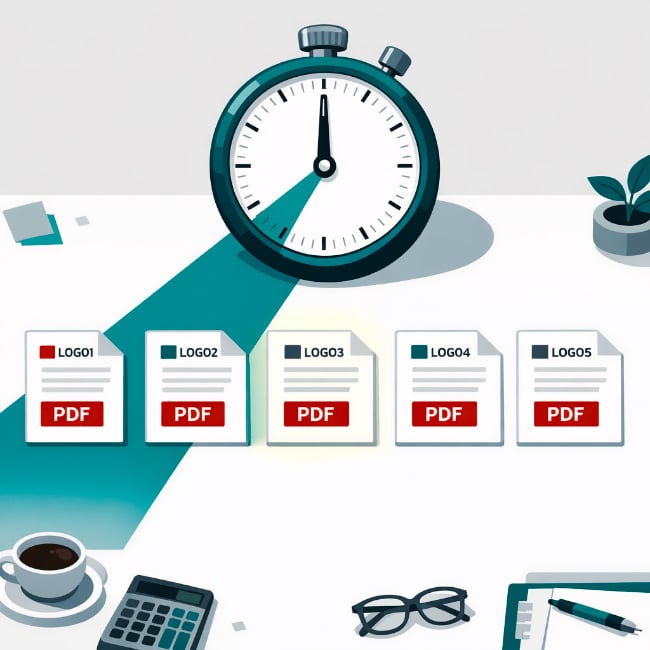
Now picture the other side. A procurement manager at a mid-size manufacturer is evaluating five potential suppliers for a stamped metal assembly. She's working through her inbox on a Tuesday morning. Five emails, five PDF attachments. Every one of them is a flat document with spec tables, tolerances, and a logo in the upper left corner. Maybe yours has a slightly different color scheme. Maybe your lead times are listed on page three instead of page seven. None of that matters, because she isn't reading. She's triaging.
The seven-second scan is real. Procurement doesn't sit with your 14-page capability statement and a cup of coffee. They open, skim the first page, check whether anything visually or structurally distinguishes your document from the last four, and make a gut-level decision about whether you're worth a second look. If nothing differentiates your format, you're competing on name recognition alone. And at eight employees, you don't have name recognition. You have good specs that nobody sees long enough to appreciate.
So what does that seven-second dismissal actually cost you?

The Real Cost of Looking Like Every Other Supplier
It costs you the shortlist. When your capability statement is indistinguishable from the rest, procurement defaults to incumbents and known brands. You don't get a rejection email. You get silence. That's worse, because silence doesn't give you anything to learn from.
It costs you margin. When nothing about your presentation signals differentiated value, the buyer treats you as a commodity. The conversation, if it happens at all, starts and ends at unit cost. Your tighter machining tolerances, your shorter lead times, your engineering team that actually picks up the phone: none of that enters the equation because your materials never communicated it in a way the buyer registered.
And it costs you credibility in the subtlest, most damaging way. Procurement managers at large companies are career-risk-averse. Choosing an unknown eight-person supplier over an established competitor is a personal risk. If your capability statement looks like it was built in Word 2016, the buyer unconsciously codes you as "small and risky," even if your technical specs are superior. The perception gap between what you can do and what your materials suggest you can do is the most expensive problem you're not measuring.
For startup OEMs, this compounds. Every missed shortlist is a missed reference customer. Every price-only conversation erodes margins you can't afford to lose at this stage. The cost isn't one lost deal. It's a pattern that keeps you stuck competing on price against companies with scale advantages you'll never match that way.
At this point, most marketing directors at small OEMs reach the same conclusion. And it's usually the wrong one.
The Misdiagnosis: "We Just Need More Content"
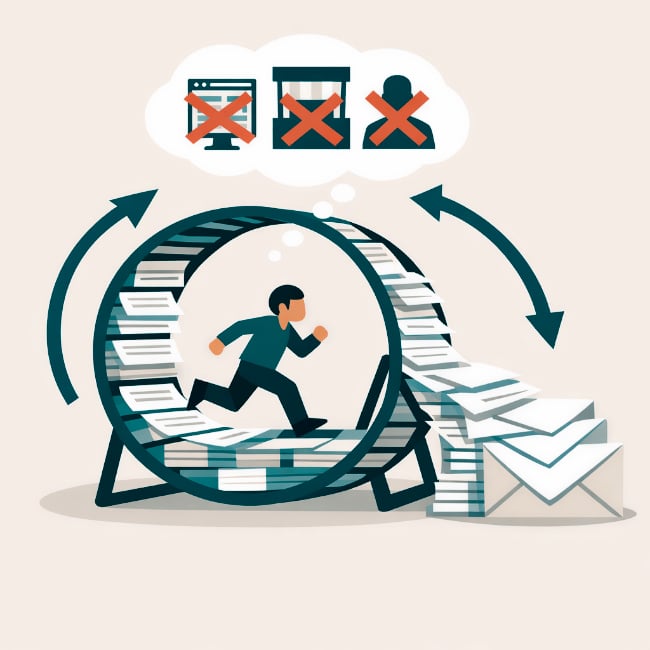
The instinct, when your materials aren't getting traction, is to produce more of them. More case studies. More sell sheets. A redesigned capability deck. At a startup with one person handling marketing, this creates a hamster wheel that never catches up to the output of a competitor with a five-person marketing team and an agency on retainer.
Here's the problem with "more": if every new document lands in the same inbox as the same kind of attachment, you've multiplied your effort without changing the outcome. You spent three weeks on a catalog refresh that arrives in procurement's inbox looking exactly like it did before the refresh. The format neutralized your work before the buyer saw a single spec.
Then comes the pressure from your founder or CEO. "We need a better website. We need to be at more trade shows. We need a sales hire." All potentially valid, but all expensive, slow, and upstream of the actual moment of decision: when the buyer opens, or doesn't open, your document. You can redesign the website for $30K and still be emailing the same flat PDF to the same procurement contact.
The reframe is this: the content you have is probably adequate. Most startup OEMs that survive past year two have solid technical content. Your spec sheets are accurate. Your product catalog covers what it needs to cover. Your compliance documentation is in order. The gap isn't what you've created. It's how that content shows up in the buyer's world. This isn't a content volume problem. It's a delivery format problem. And format problems have faster, cheaper fixes than content problems do.
So if the answer isn't more content, what does "better delivery" actually mean for technical documentation?

What Procurement Actually Responds To (It's Not Another Attachment)
Think about what buyers at larger companies are already used to seeing from established OEMs: branded, interactive digital catalogs. Embedded spec videos. Clickable product lines that let you jump straight to the component you care about. Documents that feel like an experience, not a file buried in a download folder.
That's the gap. Your competitor's product catalog lives on a branded URL the buyer can revisit any time. Yours is sitting in an Outlook attachment pane behind 47 other emails. Even if your product is better, your materials are playing a different, less visible game.
The category to pay attention to is interactive digital publications: flipbooks, digital catalogs, online spec libraries. At a high level, they work simply. You take an existing PDF, the one you already have, and convert it into an interactive, web-hosted, trackable document. No rebuild from scratch. No design team required.
For OEMs specifically, this matters more than it does in most industries. Technical documentation is dense. A 40-page product catalog with spec tables, tolerance charts, and certification listings is difficult to navigate as a static PDF. Interactive formats let buyers jump directly to the specs they care about, watch a process video embedded in context, and share the link internally with their engineering team. That last point is critical for multi-stakeholder procurement, where the initial contact might be a supply chain director but the technical sign-off comes from an engineer who never saw your email.
There's a tracking angle too. When you email a PDF attachment, you know it was sent. That's it. When you share an interactive publication link, you know it was opened, how long the buyer spent on each page, and whether they forwarded it to a colleague. Suddenly you know when to follow up, what they cared about, and how many people at the account are evaluating your product. For a startup OEM without a CRM full of intent data, that visibility is a game-changer.
This probably sounds like it requires a design team or a five-figure software contract. It doesn't.

Why This Works for Small OEMs (Not Just Companies With Design Teams)
The raw material already exists. You're not starting from zero. Every startup OEM that's made it to the point of responding to RFQs has the PDFs: the product catalog, the capability statement, the compliance package. The conversion to an interactive format doesn't require new content creation. It requires a different last step in the workflow you're already running.
The resource math is what makes this practical for a one-person team. Creating a new case study takes weeks. Converting an existing catalog into a digital publication takes minutes. When you're the only person handling marketing, that ratio isn't a minor detail; it's the difference between something that actually gets done and something that stays on the quarterly plan forever.
Think about what changes in your day-to-day. Instead of attaching a PDF to an email, you send a link to a branded digital catalog that a procurement manager can browse without downloading anything. Your capability statement, the same content you already have, now looks like something from a company with a $2M marketing budget. Your compliance documentation package, the six separate files you've been zipping together, becomes a single browsable publication the buyer can review in their browser.
That's the "punch above your weight" moment every startup OEM needs. When a procurement manager opens your interactive catalog and compares it to the flat PDF from a supplier with 400 employees and a dedicated design team, the perception of company size and professionalism shifts. You stop looking like the scrappy small shop. You start looking like the responsive, modern supplier who's easier to evaluate and easier to trust.
Your Content Isn't the Problem. How It Shows Up Is.
Startup OEMs almost always misdiagnose their marketing problem as a volume or budget issue. We need more content. We need a bigger team. We need a rebrand. The actual gap, almost every time, is between the quality of what you've built and how it presents in the buyer's world. Your specs are solid. Your engineering is sound. Your capability statement covers everything it needs to cover.
The fix is closer than a new hire or a six-month content strategy. It's closer than a website redesign or another trade show booth. It lives in that last step of the workflow, the moment between "export to PDF" and "attach to email," where a small change in format creates a completely different experience for the person deciding whether you're worth a phone call.
If you've been feeling like your materials don't do your product justice, you're right. But the problem isn't what's in the document. It's what happens to it after you hit send. And that's a problem with a faster fix than you think.